How to Study for the AP Calculus AB Exam: 12 Tips for a 5
How to study for the AP Calculus AB exam with 12 proven strategies. Free study plan, FRQ tips, and practice methods to walk in ready for a 5.
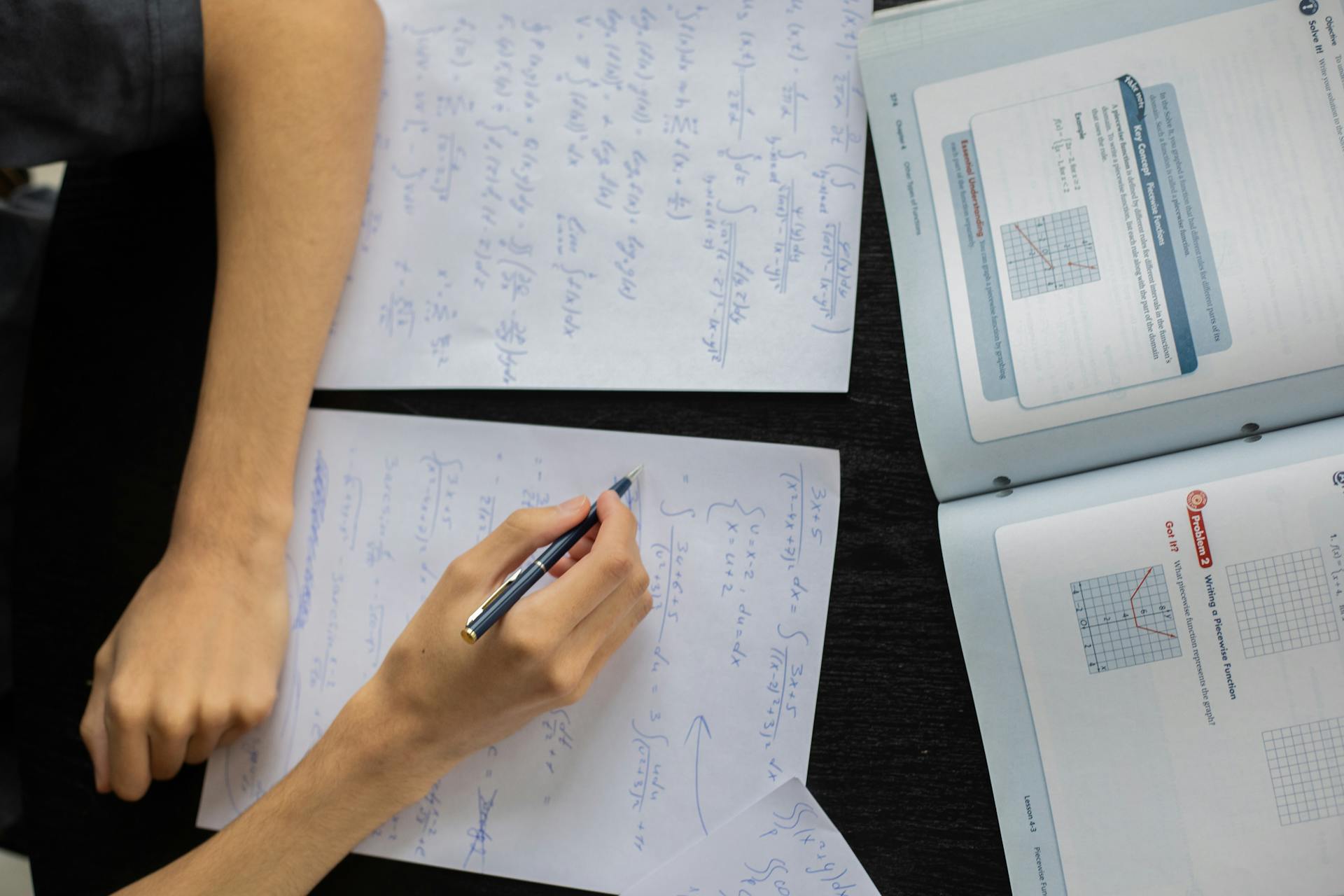
AP Calculus AB rewards students who can read a problem, choose the right tool, and explain their work clearly under time pressure. Reading the textbook one more time rarely closes the gap between a 3 and a 5. What actually moves the score is targeted practice on the exact question types the College Board uses, plus a system that catches your weak spots before May.
Most students try to memorize every derivative rule and theorem, then panic when an FRQ asks them to interpret the meaning of a definite integral in context. The fix is not more content review. The fix is shifting from passive reading to active retrieval, mock exams under timed conditions, and a feedback loop that names exactly what you missed and why. StudyCrush's AI math solver turns lecture notes, problem sets, and review books into the kind of step-by-step practice the AP exam actually tests.
Table of Contents
- What Is the AP Calculus AB Exam, and How Is It Scored?
- How Early Should I Start Studying for AP Calculus AB?
- Can Practice Exams Really Move My Score?
- 12 Tips to Study for the AP Calculus AB Exam and Score a 5
- How StudyCrush Makes AP Calculus AB Prep Easier
- Stop Cramming. Study Smarter With StudyCrush for Free Today!
Summary
Students who treat AP Calculus AB as a writing exam as much as a math exam consistently score higher than those who only grind through derivatives. The free-response section is graded against a public rubric that rewards explicit setup, correct notation, and contextual interpretation. According to recent College Board data, only about 22 percent of students earned a 5 on the May 2025 AP Calculus AB exam, and the biggest separator between 4s and 5s was clear communication on FRQs, not raw calculation speed.
Starting structured AP Calculus AB prep in mid-January gives you roughly sixteen weeks before the exam, enough time to layer review on top of new content without cramming. By January your class has typically covered limits, derivatives, and the early integration units. That foundation lets you practice mixed problems that connect related rates to optimization or link the Mean Value Theorem to accumulation, the exact conceptual bridges FRQs reward.
Practice exams under realistic timing improve scores faster than any other single study method. Retrieval practice strengthens neural pathways in ways rereading notes never does, and timed sections train pacing across forty-five multiple-choice questions and six FRQs. Students who complete at least three full timed practice exams before May report sharper accuracy on Section II and fewer skipped sub-parts on the investigative-style problems where partial credit is most generous.
Calculator strategy is often the difference between earning a 4 and a 5. The exam has a calculator-active section and a no-calculator section, and AP graders publicly reward students who name the function and the operation rather than just writing a number. Practicing both modes weekly, and explicitly writing out the integral or derivative you typed before the result, protects partial credit even when you make an arithmetic slip.
Mistakes hold more useful information than correct answers, but only if you log and analyze them. Students who keep a weekly error log of the exact mistake (sign error, missed condition, wrong rule) and the underlying concept improve faster than students who just retake whole exams. The pattern in your log tells you what to drill next week.
StudyCrush addresses all of this by converting your lecture slides, textbook chapters, and prior FRQs into adaptive quizzes, flashcards, and step-by-step solver sessions that train active recall and rubric-aware communication, instead of leaving you to build study materials from scratch.
What Is the AP Calculus AB Exam, and How Is It Scored?
The AP Calculus AB exam is a three-hour-fifteen-minute test that covers a full semester of college calculus: limits, derivatives, integrals, the Fundamental Theorem of Calculus, and basic differential equations. It is built around eight units, with derivatives and integrals making up the heaviest weighting on both sections. The official structure and unit weightings are documented in the College Board AP Calculus AB Course and Exam Description, which is the single most underused free resource in the entire prep ecosystem.
🎯 Key Point: Section I and Section II each count for 50 percent of your final score. Strong calculation skill alone is not enough. The FRQs reward setup, notation, and context as much as the right number.
The test uses the digital Bluebook app for multiple-choice and a paper booklet for the free-response section. A graphing calculator is required for one part of each section and prohibited in the other, and the College Board explicitly tests whether you know when to use it and when to do work by hand.
How the Two Sections Are Structured
| Section | Format | Time | Questions | Calculator | Score Weight |
|---|---|---|---|---|---|
| I, Part A | Multiple-choice | 60 min | 30 questions | No | ~33% |
| I, Part B | Multiple-choice | 45 min | 15 questions | Yes | ~17% |
| II, Part A | Free-response | 30 min | 2 questions | Yes | ~17% |
| II, Part B | Free-response | 60 min | 4 questions | No | ~33% |
Section I is graded by computer. There is no penalty for guessing, so always answer every question even if you have to bubble at the last minute. Section II is hand-graded by AP Readers using a published rubric. Each FRQ is worth nine points, and partial credit is generous when your reasoning is clear.
What the Score Distribution Actually Looks Like
Looking at the May 2025 release, the score distribution was roughly: 22% earned a 5, 17% earned a 4, 21% earned a 3, 22% earned a 2, and 18% earned a 1. About 60 percent of students earned a 3 or higher, which most colleges accept for credit, but the jump to a 5 narrows quickly. The students who land there almost always share three habits: they practice timed FRQs from released exams, they write out their setup before computing, and they review every mistake instead of moving on.
💡 Tip: Most colleges grant credit for AP Calculus AB at a 4 or 5. A handful of selective schools require a 5. Check the credit policy for the schools you are targeting before you set your goal score.
Why the Format Matters for Your Study Plan
If you treat AP Calculus AB the way you treat a typical school test, by rereading the textbook the week before, you will run out of time on Section II and lose easy partial-credit points on every FRQ. The format demands a different kind of preparation: hand-writing solutions with proper notation, switching calculator modes cleanly, and explaining what a derivative means in a real-world context such as a rate of population change.
StudyCrush's AI math solver walks every step of a problem with the rule named, so you learn the workflow the exam actually scores instead of just chasing the final number.
How Early Should I Start Studying for AP Calculus AB?
Start structured AP Calculus AB prep in mid-January, right after winter break. That gives you about sixteen weeks before the May exam, the sweet spot where review reinforces what you already know rather than introducing brand-new material.
⚠️ Warning: Waiting until April leaves no time to fix systemic problems like weak related-rates intuition or unclear FRQ communication. Students who start late often plateau at a 3 even when they put in long hours, because they never get enough timed reps under exam conditions.
Why January Is the Sweet Spot
By mid-January, most AP Calculus AB classes have completed Units 1 through 6: limits, derivatives, applications of derivatives, the basics of integration, and the Fundamental Theorem of Calculus. Together those units carry over 70 percent of the exam's weight. Starting your review here means every practice problem reinforces material you have already met in class, rather than forcing you to teach yourself units that have not been covered yet.
Earlier starts often waste effort because you end up re-learning topics the teacher will cover anyway. Later starts compress practice into a stressful sprint that hurts retention.
What a Sixteen-Week Plan Looks Like
| Phase | Weeks | Focus |
|---|---|---|
| Foundation review | Jan, weeks 1-4 | Limits, derivatives, derivative applications, key theorems |
| Integration block | Feb, weeks 5-8 | Definite integrals, FTC, accumulation, area between curves |
| Mixed practice | Mar, weeks 9-12 | Mixed MCQs, timed FRQ sets, calculator vs. no-calculator drills |
| Peak performance | Apr-May, weeks 13-16 | Full timed mocks, FRQ rubric review, weak-spot drilling |
Plan about six focused hours per week. That is enough to make real progress without burning out during a season when you may also be prepping for the SAT, finals, or other APs.
How a Modern Study Workflow Cuts the Setup Time
Traditional review wastes hours on setup: rewriting notes, typing flashcards by hand, hunting down practice problems online. StudyCrush converts your lecture slides, your Princeton Review chapter, or even a photo of last year's FRQ into interactive quizzes, flashcards, and a step-by-step tutor in seconds. That setup time goes back into active practice, which is the actual driver of score gains.
Can Practice Exams Really Move My Score?
Yes, more than any other single study tactic. Practice exams force you to retrieve information under pressure, build pacing across a three-hour block, and surface the exact gaps that passive review hides.
🎯 Key Point: Reading a worked solution is not practice. Practice means producing the answer yourself, from a blank page, in the time the exam gives you.
Why Retrieval Beats Rereading
When you reread your notes, your brain recognizes the material and feels comfortable. That comfort is a trap. Recognition is not the same as recall. On exam day the page is blank, the clock is running, and the question is phrased in a way your textbook never used.
Retrieval practice, where you actively pull the answer from memory, strengthens the exact neural pathways the exam will pull on. Roediger and Karpicke's 2006 study published in Psychological Science ("Test-Enhanced Learning: Taking Memory Tests Improves Long-Term Retention") found that students who self-tested on material outperformed students who reread the same material by a wide margin on a one-week delayed test, even when total study time was identical. Dunlosky et al.'s 2013 meta-review in Psychological Science in the Public Interest ranked practice testing as one of only two study techniques with the highest level of empirical support across hundreds of studies.
What a Smart Practice Schedule Looks Like
Take your first full-length timed practice exam in early February, before you feel ready. The point is not the score. The point is the diagnosis. You will discover, in two and a half hours, exactly which units cost you the most points and which question formats slow you down.
After that, run one full mock every two to three weeks, with a deep error-review session the next day. By April you should have completed three to four full mocks, including at least one released College Board exam with the official rubric in hand.
Use Released FRQs, Not Just Textbook Practice
The College Board posts every previous AP Calculus AB FRQ on the AP Central past exam questions archive with the official scoring rubric. Use them. The phrasing, calculator expectations, and emphasis on context match the real exam in a way that textbook problems often do not.
For a one-sitting full review of the entire course, The Organic Chemistry Tutor's Calculus 1 Final Exam Review is the single most-watched calc review on YouTube and covers limits, continuity, derivatives, and integration with worked examples. Drop it in alongside your own retrieval practice for the topics that still feel shaky.
| Practice Source | What It's Best For |
|---|---|
| Released College Board FRQs | Exact format, rubric language, real difficulty |
| Princeton Review or Barron's | Targeted unit drills, full-length practice sets |
| Your class problem sets | Concept reinforcement, foundational reps |
| StudyCrush AI math solver | Step-by-step walkthroughs of any problem you get stuck on |
How to Use AI on Top of Practice Tests
The biggest mistake students make with practice tests is finishing the exam, scoring it, and moving on. The real value is in the review. After every miss, write out the correct full solution from scratch and name the rule you should have used. StudyCrush's AI tutor can walk you through any FRQ step by step, explain why your approach failed, and generate three similar practice problems on the same concept so you actually lock it in.
Related Reading
12 Tips to Study for the AP Calculus AB Exam and Score a 5
The students who score 5s do not necessarily work more hours than the students who score 3s. They work on the right things in the right order. These twelve tips focus on the high-leverage habits that move the score, not the long list of nice-to-haves.
💡 Tip: Pick three of these to start this week. Trying to install all twelve habits at once almost never works. Pick the three that match your weakest area, run them for two weeks, then layer in more.
1. Master the Unit Weights Before You Start Studying
Spend your first prep session reading the AP Calculus AB Course and Exam Description and writing down the percentage weighting of each unit. Derivatives and their applications make up roughly 40 to 50 percent of the exam. Integrals and accumulation add another 20 to 30 percent. Spending equal time on every unit is a mistake. Spend the most time on the units that carry the most points.
2. Build a Personal Rule Sheet From Scratch
Get a single piece of paper and write down every rule and theorem you are responsible for: power rule, chain rule, product and quotient rules, the Mean Value Theorem, the Intermediate Value Theorem, the Fundamental Theorem of Calculus in both forms, basic antiderivatives, integration by substitution. Do it from memory first, then check. The act of writing the sheet from scratch makes you confront which rules you actually own and which ones you only recognize.
3. Drill the Algebra and Trig You Will Need
Most AP Calculus AB mistakes are not calculus mistakes. They are algebra mistakes: a sign flip on a derivative, an unsimplified fraction that hides a zero, a missed factor in an exponent. Spend one short session per week on raw algebra and trig drills. Solving for x, manipulating exponents, simplifying rational expressions, and the unit circle should be automatic before May.
4. Practice in Both Calculator Modes Every Week
Half the exam is no-calculator and half is calculator-active. The skills are different. In the no-calculator section you need clean algebraic manipulation and clean integration by hand. In the calculator section you need to know when to define a function in your calculator, when to use a numerical integral, and how to interpret a graph. Train both modes weekly so neither one surprises you in May.
⚠️ Warning: AP graders explicitly reward students who write out the integral or derivative they typed into the calculator. A bare numerical answer with no setup earns less credit than a clean setup plus the same number.
5. Write Out the Setup Before You Compute
On every FRQ, write the formula or integral you are evaluating before you compute the value. This is the single highest-leverage habit on the exam. The setup line is worth a point even if your arithmetic is wrong. Computing first and writing the setup as an afterthought loses partial credit that would otherwise have been easy.
6. Learn to Interpret in Context
The FRQs love to ask what a derivative or integral means in a real situation. If the function is the rate at which water flows into a tank in gallons per minute, the integral from 0 to 5 of that function is the total gallons of water that flowed in over the first five minutes. Practice writing one-sentence interpretations that name the quantity, the units, and the time interval. AP graders look for all three.
7. Use the Error Log Method
Keep a single document where you log every mistake from every practice problem and exam. For each error, write the problem, what you wrote, the correct answer, and the underlying concept you missed. Review the log weekly. After a few weeks, patterns will jump out. You will discover, for example, that you consistently miss problems involving the Mean Value Theorem or that you keep forgetting the sign on the derivative of cosine.
8. Run Timed FRQs Every Weekend
Once per week, set a timer for fifteen minutes and complete one FRQ from a released exam. Treat it like the real thing: no notes, no internet, calculator only when allowed. Grade yourself against the published rubric the next day. Most students need three or four cycles before their FRQ scores stabilize, so start in February to give yourself time.
9. Master the Big Theorems Verbally
You should be able to state the Intermediate Value Theorem, the Mean Value Theorem, and both forms of the Fundamental Theorem of Calculus in plain English without notes. Practice explaining each theorem to a friend who has never taken calculus. If you cannot explain it simply, you do not understand it well enough to apply it under exam pressure.
10. Build Mixed-Topic Problem Sets
Most class problem sets group by unit, so you know every problem in the section is about related rates or optimization. Real AP exams shuffle units together. Build your own mixed sets of fifteen problems pulled from different units, and time yourself. You will quickly see which topic transitions trip you up, like jumping from a definite integral question to a derivative question without losing speed.
11. Sleep, Food, and a Quiet Hour Before the Exam
The week before the exam is not the week to learn new material. Get eight hours of sleep at least three nights in a row before exam day. Eat a real breakfast. Spend the hour before the exam doing five or six easy problems to warm up, then close your notes. Going into the exam relaxed and recently warmed up beats going in exhausted from a final all-nighter.
12. Use AI Tools to Compress Setup Time
Manually creating flashcards from your textbook, hand-writing summary sheets, and hunting for similar practice problems eats hours that should go into actual retrieval practice. StudyCrush transforms a chapter, a lecture video, or a worksheet photo into interactive flashcards, quizzes, and a step-by-step solver in seconds. The AI tutor walks you through any miss with the rule named, and you can generate three more practice problems on the same concept with one click.
💡 Tip: Snap a photo of a problem you got stuck on with the StudyCrush mobile workflow. You get the full worked solution, an explanation of the rule used, and the option to generate similar practice. That is the loop high scorers run weekly.
How StudyCrush Makes AP Calculus AB Prep Easier
You finish another worked example and the steps look obvious, but when you sit down to a blank page on a similar problem the next day, you blank. The issue is not effort. It is the gap between recognition and recall, and that gap is what AP Calculus AB measures.
🎯 Key Point: The exam tests whether you can produce a solution from a blank page, with correct notation, under time pressure. Passive review of worked examples cannot build that skill. Active retrieval can.
StudyCrush is built around active retrieval, the single technique cognitive science consistently ranks at the top for long-term learning.
Turn Any Material Into a Study Set in Seconds
Upload a chapter from your Princeton Review, a photo of last year's FRQ, your teacher's slide deck on related rates, or a YouTube lecture link. Within seconds you have an editable set of flashcards, a quiz on the key concepts, and a step-by-step solver you can use on any practice problem. No more hand-typing flashcards from a textbook at 11 p.m.
Step-by-Step Solver That Names the Rule
When you get stuck on a problem, the AI math solver walks you through every step with the rule named at each line. You see why the chain rule applies before you see the calculation. That structure is the workflow AP graders actually score on Section II, and practicing it weekly trains the habit that earns partial credit on exam day.
Adaptive Practice Targeted at Your Weak Spots
The quizzes adapt based on your performance. If you keep missing related-rates problems, the system surfaces more of them and reduces the share of topics you have already mastered. Time spent on review goes where it matters instead of being spread evenly across material you have already locked in.
FRQ-Style Practice With Rubric-Aligned Feedback
Generate AP-style free-response prompts from any chapter and write your answer in the workspace. The system points out where your communication is unclear, where you skipped a setup line, and where the rubric would award or withhold points. This is the part most students never practice deliberately, and it is the part that separates a 4 from a 5.
Mobile Workflow for Snap-and-Solve Practice
Snap a photo of a problem on the bus, in the cafeteria, or during a study group. The solver returns a full step-by-step solution, explains the rule, and gives you three similar practice problems on the same skill. Five minutes of focused retrieval beats thirty minutes of staring at a textbook.
Related Reading
- How to Build an AP Exam Study Plan With an AI Tutor
- AI Math Solver
- Math Homework Helper
- AI Physics Solver
- SAT Prep AI
- AI Tutor
Stop Cramming. Study Smarter With StudyCrush for Free Today!
If you have read this far, you already know the difference between a 3 and a 5 is not raw hours. It is the type of practice you do with those hours. Rereading the textbook for the fourth time will not move your score. Solving twelve fresh problems with the rule named at each step will.
🎯 Key Point: Active retrieval, rubric-aware FRQ practice, and a weekly error log are the three habits that consistently separate 5s from 4s. StudyCrush is built to run that loop for you.
Upload your AP Calculus AB notes, your Princeton Review chapter, or a photo of any practice problem and StudyCrush turns it into flashcards, quizzes, and a step-by-step solver in seconds. The AI tutor walks every step with the rule named, you can generate three similar practice problems on any miss, and the dashboard shows you exactly which units still need work.
No credit card required to start. Start your first AP Calculus AB study set free on StudyCrush and see, in five minutes, what a real retrieval-based workflow feels like before exam day.
Sources & Further Reading
- AP Calculus AB Course Page on AP Central
- AP Calculus AB & BC Course and Exam Description (PDF)
- AP Central Past Exam Questions (FRQs and scoring guidelines)
- The Organic Chemistry Tutor — YouTube channel
- Khan Academy AP Calculus AB
- Roediger, H. L., & Karpicke, J. D. (2006). Test-Enhanced Learning. Psychological Science, 17(3), 249–255.
- Dunlosky, J., Rawson, K. A., Marsh, E. J., Nathan, M. J., & Willingham, D. T. (2013). Improving Students' Learning With Effective Learning Techniques. Psychological Science in the Public Interest, 14(1), 4–58.
Related Articles
- How to Build an AP Exam Study Plan With an AI Tutor
- How to Study for APUSH: Complete AP US History Study Plan & DBQ Guide
- Best AI Study Tools for College Students in 2026 (Tested & Compared)
Ready to study smarter
with AI?
Get StartedRelated articles

Best AI Study Tools for College Students in 2026 (Tested & Compared)
The best AI study tools for college students in 2026, tested and compared. Find the right AI tutor, flashcard maker, and PDF summarizer for your major.

How to Build an AP Exam Study Plan With an AI Tutor (2026 Guide)
Build a complete AP exam study plan with an AI tutor. 16-week schedule, FRQ practice, weak-spot drills, and timed mocks for any AP exam in 2026.